Kombucha Tea: The Beginner’s Guide to Brewing, Benefits & The Tea of Immortality


If you go into any health food store and even many other stores that sell drinks, you will find kombucha, often in a huge variety of brands and flavors.
Although it’s been around for thousands of years, it’s only in recent years that it’s gained popularity in the United States and is being hailed as a healthy drink with numerous benefits, which we will cover in this guide.
Firstly let’s start at the beginning…
What is Kombucha?

Kombucha is a fermented tea drink.
It is naturally effervescent, much like carbonated beverages, and contains tea, water, sugar, healthy bacteria, and yeast.
The healthy bacteria and yeast work together to ferment this beverage, giving kombucha its many health benefits.
Now, here are a few of the reasons as to why kombucha is such a popular drink:
Easy to Make
We’ll go into more detail later, but the basic process of brewing kombucha involves making tea with sugar, then adding a SCOBY (a symbiotic culture of bacteria and yeast), and allowing it to ferment for a set number of days.
Because it’s so easy to make, many people prefer to make their own kombucha rather than buy it in stores.
Variety of Flavors
Because you can start with nearly any type of tea and add additional flavors after brewing, the possibilities for kombucha flavors are endless.
You can also find kombucha in the store in many different flavors, so there’s always something new to try and tantalize your taste buds.
Good Soft Drink Alternative
For people who love the carbonation of sugary soft drinks, kombucha makes an excellent alternative.
It’s not only got the fizziness that makes soft drinks stand out, but it’s also much lower in sugar without lacking in flavor.
The fact that there is a healthy alternative to soft drinks is great news for people who want to kick that addiction without losing out on enjoying a delicious beverage.
Low in Caffeine
While some people may need caffeine in their tea to get a little boost to make it through the day, others prefer lower-caffeine varieties because of how it affects them, such as keeping them from falling asleep at night.
Because of the fermentation process, kombucha provides many of the benefits of tea without the added caffeine.
Relaxing
One of the natural by-products of the fermentation process is alcohol.
The amount increases with the length of time the kombucha is allowed to ferment, so this is strictly controlled in a commercial setting and can be experimented with at home.
However, because of this low alcohol content, kombucha will help anyone who drinks it to relax.
Healthy
Easily the biggest reason kombucha has gained popularity is its many health benefits.
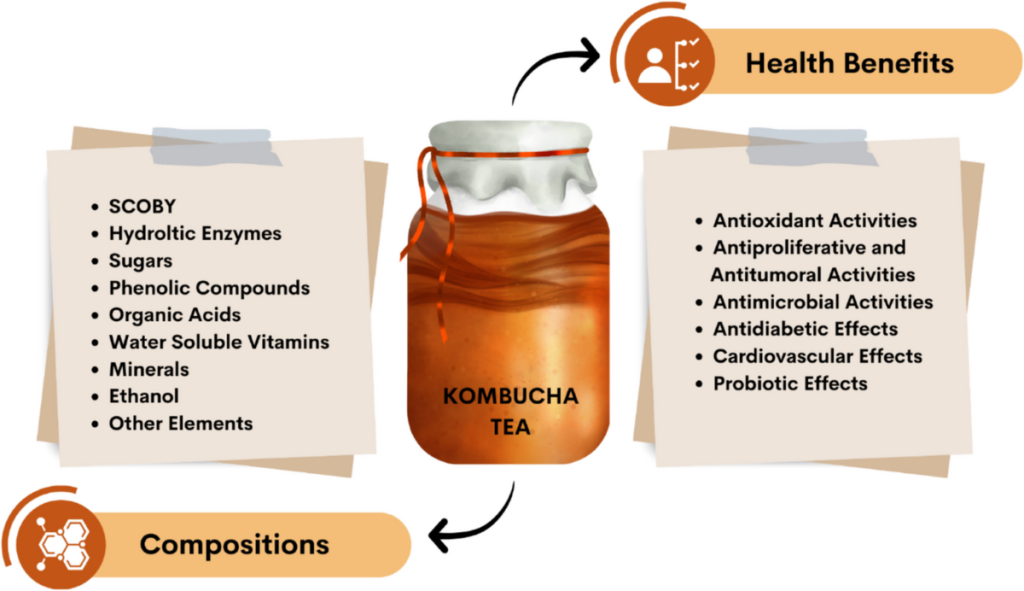
It contains probiotics, which can help with digestive issues; antioxidants, which can help remove toxins from your body; and B vitamins, which help in a number of ways within your body.
It’s also low in sugar, calories, and sodium, making it great for people who are trying to lose weight.
Well, that’s a basic overview of what Kombucha is and why it’s gaining notoriety as a miracle elixir for overall health
In the next part, we’re going to take a look at the history of Kombucha and how it’s evolved over time
Let’s dive in…
History Of Kombucha Tea

Nobody knows for sure how far back kombucha goes, and the truth has been so mixed with legends over the years that it’s hard to separate them now.
But we’re going to do our best to present you with the history of kombucha tea and how it evolved from an ancient Chinese medicinal drink into a modern-day health beverage around the world.
First Mention
The first recorded mention of kombucha goes back to 220 BC during the Qin Dynasty in China.
It was said to have been used as a drink of immortality by Emperor Qin Shi Huangdi.
This is likely where it gets the “cha” part of its name, as the Chinese word for tea is “cha.”
The Chinese also called this drink “stomach treasure,” “sea mushroom,” and “tea mold.”
Dr. Kombu
Supposedly, in the year 414 AD, a Korean doctor by the name of Dr. Kombu brought the drink to Emperor Inyoko of Japan, and this is where the drink gets its name.
However, there isn’t enough evidence to back up this story, so it could be the stuff of legends.
Another story is that Ghengis Khan carried kombucha with him as he traveled.
Russia and Beyond
From Asia, kombucha found its way to Russia as well as Europe, where it not only gained in popularity until the 19th century, but also gained a few more names, such as in Russia where it is referred to as “tea mushroom.”
According to one account, this beverage saved the life of Alexsander Solzhenitsyn, a Nobel Prize winner, while he was in exile in Siberia.
World War II
Kombucha remained popular throughout Europe and Russia until the beginning of World War II.
This was because both tea and sugar were rationed and it was too hard for the average citizen to get their hands on enough of them to regularly make the drink.
After the war, however, it began to grow in popularity again and saw a surge in the 1960’s when Swiss researchers proved its health benefits.
Chernobyl
In the 1980’s, there was a horrific accident near Chernobyl in Russia where a nuclear plant melted down, exposing hundreds of people nearby to radiation.
There was a group of people, primarily elderly women, who survived and did better than the others.
Scientists and doctors found that these people regularly drank kombucha.
Modern Popularity
Since the year 2000, kombucha has become a popular health drink throughout the Western world, with people all over Europe, the United States, and Australia enjoying its numerous health benefits.
Unfortunately, as many hail this drink as a miracle cure for a number of ailments, others claim it to be dangerous.
Because it is created through a natural process and cannot be patented, big companies have little interest in it, which is why there have been few studies done on kombucha to provide completely conclusive evidence one way or the other.
Now that we’ve uncovered what Kombucha is and the history of this tea, the next thing to do is explain how it’s made…more specifically the SCOBY (Mother), which is what we will cover in the next part.
The Mother (SCOBY)
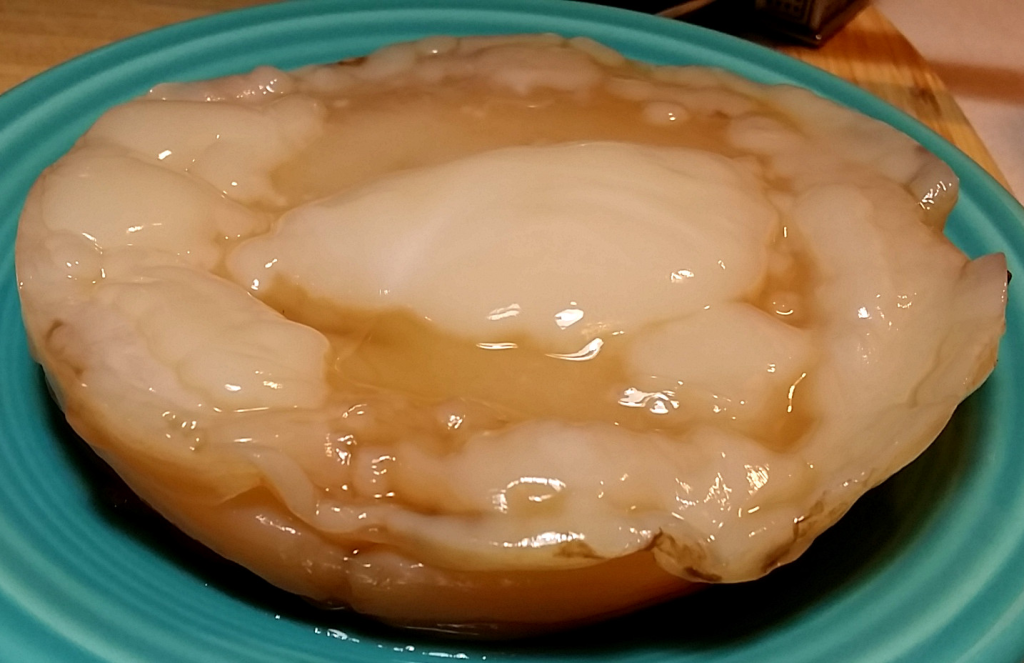
What sets kombucha apart from other health drinks is the process by which it is made.
That process begins with something commonly referred to as a SCOBY, but may also be called “kombucha mushrooms” or “kombucha mothers.”
These mothers are responsible for the fermentation process that turns tea into kombucha.
What is SCOBY?
SCOBY stands for Symbiotic Culture Of Bacteria and Yeast.
During the brewing process, it can be found floating on the top of the kombucha, and is removed before bottling.
It is disc-shaped and has a gooey, unappealing appearance and consistency.
But, if you want to brew your own kombucha, then you need a SCOBY to do it!
Let’s break down the different parts of SCOBY.
Symbiotic – This means that things work together for mutual benefit.
In this case, the bacteria and yeast work together to thrive in the tea and sugar environment, and then you get the biggest benefit of kombucha.
Culture – This refers to the microorganisms (bacteria and yeast) that have been allowed to grow for a specific purpose.
Bacteria – The type of bacteria found exclusively in kombucha and unique to it is Gluconacetobacter kombuchae.
It thrives in the airless environment and feasts on the tea and sugar, turning it into several types of acids that give kombucha its tartness.
These bacteria are, of course, beneficial and shouldn’t be confused with those that cause disease.
Yeast – This is another organism that isn’t going to hurt you.
Zygosaccharomyces kombuchaensis is the type of yeast unique to kombucha, and as it consumes sugar, it produces gases as a by-product that give kombucha its signature effervescence.
Bacteria and Yeast Found in SCOBY
In addition to the unique bacteria and yeast mentioned above, kombucha also contains a number of other bacterial and yeast species.
All of these work together to create the kombucha, as each produces something different after the tea and sugar are consumed.
The exact makeup of bacteria and yeast in a SCOBY varies greatly depending on the region in which they are found.
Growing Your Own SCOBY
Brewing your own kombucha starts with having SCOBY.
Fortunately, it’s easy to get one.
If you have friends who are growing kombucha, you can ask them for a “baby” after their next batch, or you can even order one online.
A baby SCOBY is a smaller piece of a larger mother SCOBY, and it will grow into a mother SCOBY after it finishes its first batch of kombucha.
It’s important to take good care of your SCOBY since it is made up of living things.
You need to make sure it’s kept in the right environment at the correct temperature, and that it has plenty of food.
By taking good care of your SCOBY, you will have an infinite supply of it and be able to make as much kombucha as you want.
Well, that’s an introduction to what is needed to make kombucha. In the next chapter, we will cover one of the most frequently asked questions and hesitations when considering drinking Kombucha for health…Is it safe?
Is Kombucha Right For Me & Is It Safe
Whenever you’re considering putting anything into your body, it’s important to take the time to make sure it will benefit you rather than harm you.
This is especially important if you decide to make your own kombucha.
Store-bought kombucha is often pasteurized and tested to ensure it’s safe, but if you’re brewing your own, there are some dangers to consider.
It’s a wild ferment
That means that you have little to no control over what exactly is growing in your kombucha.
Although it’s supposed to only contain good bacteria, a surprising number of SCOBY’s in homebrewed kombucha have harmful types of bacteria and yeast growing in them, some of which you will end up drinking, which can lead to problems.
Because you probably lack the equipment to test your own kombucha, you have to be extremely careful about these possible contaminants.
These can come from not properly sanitizing a container, touching the SCOBY with unwashed hands, or from unknown environmental factors.
If you are worried about keeping your kombucha safe, it might not be for you.
It’s a biosorbent
The SCOBY used to make kombucha is a biosorbent, meaning it binds to various contaminants and heavy metals.
In fact, several studies have shown that SCOBY can be used to remove harmful contaminants from wastewater.
What’s dangerous about this factor is that those contaminants and heavy metals can find their way into your kombucha.
What’s important to keep in mind is that the SCOBY must come into contact with these contaminants before it can absorb them, which can happen if it is improperly stored in a container containing something like lead or if unfiltered tap water is used.
Tap water contains trace amounts of heavy metals that the SCOBY will concentrate over time, leading to possible poisoning.
It Contains Unmeasured Amounts Of Alcohol
For this reason, children should never drink homebrewed alcohol, since there’s no guarantee of how much alcohol is in it.
Even the commercially-bottled types have some alcohol, so if you do want to give kombucha to your kids, be sure to find one that has the least amount or no alcohol in it.
People who are sensitive to alcohol should also avoid homebrewed kombucha for this reason.
It Contains Sugar
Although much of the sugar is consumed by bacteria and yeast during the fermentation process, there is still quite a bit of sugar remaining in the drink afterwards.
If you’re trying to eliminate sugar from your diet, then kombucha probably isn’t right for you, especially when you brew it yourself and can’t know exactly how much sugar is left after fermentation.
Bottom Line
When done properly, kombucha can be safely made at home and enjoyed by everyone in the family.
However, when handled casually, you may face some serious consequences.
Before you jump into brewing your own kombucha, make sure you’re prepared to take steps to reduce or eliminate these risks.
Now that we’ve covered the issues that lead to kombucha not being safe to consume, in the next part we will briefly look at some of the benefits of kombucha and whether the truth lives up to the hype
Benefits Of Kombucha & Does It Live Up To The Hype
There are some pretty outrageous claims out there about what kombucha can do, so it’s hard to know for sure what’s true and what’s been greatly exaggerated.
We’ve taken the time to find the benefits of kombucha tea that actually have some backing.
Since these claims have actually been tested and researched, we’re confident that they are true.
1. Probiotics
Probiotics are the good bacteria that help your body in a number of ways.
They not only aid in digestion, which helps if you have stomach issues, but they also help keep bad bacteria numbers low, so they can’t affect you.
Probiotics and good gut health have even been linked to weight loss, but what do these have to do with kombucha?
As you already know, kombucha is created when bacteria and yeast work together to break down the sugars in tea.
Many of these beneficial bacteria will break off from the SCOBY during fermentation and end up in the drink itself.
These live healthy bacteria can then thrive in your digestive tract where they can provide you with a number of benefits.
2. Antioxidants
Your body builds up toxins because of everything from cellular activity to eating processed foods and smoking.
These toxins damage your body at the cellular level and can cause a number of negative symptoms: fatigue, weight gain, illness, and even cancer.
To remove these toxins from your body, you need antioxidants that bind to them and take them out of your body.
Because kombucha is made from tea, which is rich in antioxidants, kombucha itself has a number of these compounds that can help you burn more calories, lower your cholesterol, and help you regulate your blood sugar.
This is especially true of kombuchas that are made with green tea, since green tea contains more of these antioxidants than other types of tea.
3. Anti-Bacterial
When you have high levels of bad bacteria in your digestive system, it can lead to a number of health problems, including constipation, anemia, respiratory problems, allergies, high cholesterol, vitamin deficiencies, and hormone imbalances.
Many of these are caused by weakened gut walls, which allow bacteria and other toxins to enter the bloodstream and affect other areas of the body.
However, because acetic acid is present in kombucha, it helps control these harmful bacteria and keep them from causing these problems.
This acid is also found in vinegar and is produced by the good bacteria in the SCOBY during the fermentation process.
By regularly drinking kombucha, you can regulate the number of bad bacteria to stay healthier and feel better.
Other Benefits of Kombucha Tea
There are several other studies that indicate kombucha tea could help with other health problems, but these are not as well-documented as the previous items on this list.
These other benefits include reduced risk of heart disease, improved management of type 2 diabetes, and prevention of certain types of cancer.
Well, those are some of the major benefits of kombucha, well-documented. In the next part, we will move on to different brewing methods…Onward we go!
Kombucha Tea Brewing Methods
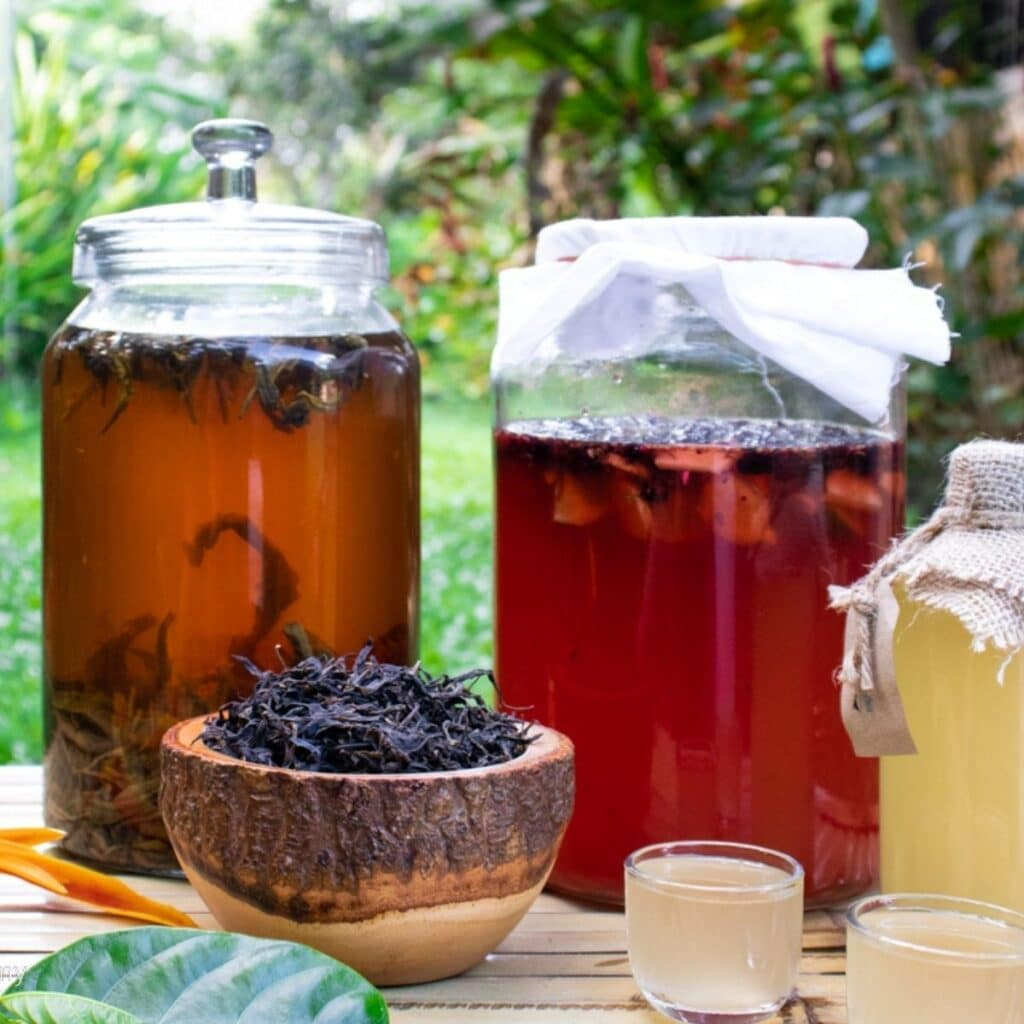
There are two main methods of brewing kombucha, each with its own advantages and disadvantages.
Choosing a method will depend on your personal preferences, particularly on which one works best for you and your family.
You can also try different brewing methods before settling on one, or switch if what you’re doing isn’t working anymore.
Continuous Brewing
This method involves constantly having the same jar of kombucha brewing new tea as you add to it and drink from it at will.
This method is much similar to the way that kombucha has been made since ancient times.
Essentially, once your first batch is fermented, you can start drinking from the tap in the jar, and then as it gets low, add new tea on top.
Advantages of Continuous Brewing
Safer – Because the SCOBY is handled less in this method, there is a much lower risk of contamination between batches, making the kombucha much safer for you.
Easier – Since you don’t have to thoroughly clean your system every time you start a new batch, it’s much easier to brew continuously.
Faster – Once you get the system going, new kombucha brews much faster because you don’t have to start from scratch every time, which means a more continuous supply of fresh kombucha.
Disadvantages of Continuous Brewing
Sour – Continuous brewing can result in sour kombucha because the fermentation cycle is disrupted, and some of the bacteria that start the cycle and help prevent excessive acid buildup become less active.
Unpredictable – Because you are constantly adding new tea and taking out fermented tea, the process and therefore the flavor becomes unpredictable, and it’s difficult to get consistency with batches.
Batch Brewing
With batch brewing, you brew your kombucha one batch at a time.
Once the fermentation process is complete, you’ll bottle all your kombucha, clean your system, and can use the same SCOBY as a starter for a brand-new batch.
Because you will be handling the SCOBY more often, it’s important to maintain strict sterile procedures to avoid contamination.
Advantages to batch brewing:
Healthier – Because the kombucha is allowed to go through all the stages of fermentation, it has a more complex bacterial ecosystem, which provides more health benefits.
Consistency – Each batch will have the same base flavor, allowing you to develop recipes for flavors you and your family love that will taste the same every time.
Sweeter – Kombucha brewed in batches has a much sweeter flavor than continuously brewed kombucha and is rarely too sour.
Disadvantages to batch brewing:
Harder – Batch brewing is more difficult because it requires more time and work on your part to clean out the system between batches and to do all the bottling every time a batch is done.
Bottom Line
The more you read about the differences between continuous brewing and batch brewing, the more you will see that there are people who believe strongly in one method over the other.
However, you will have to decide for yourself which method will work best for you and give you the most health benefits.
In the next part, we will uncover different tactics for flavoring your kombucha tea.
Kombucha Flavoring Tactics
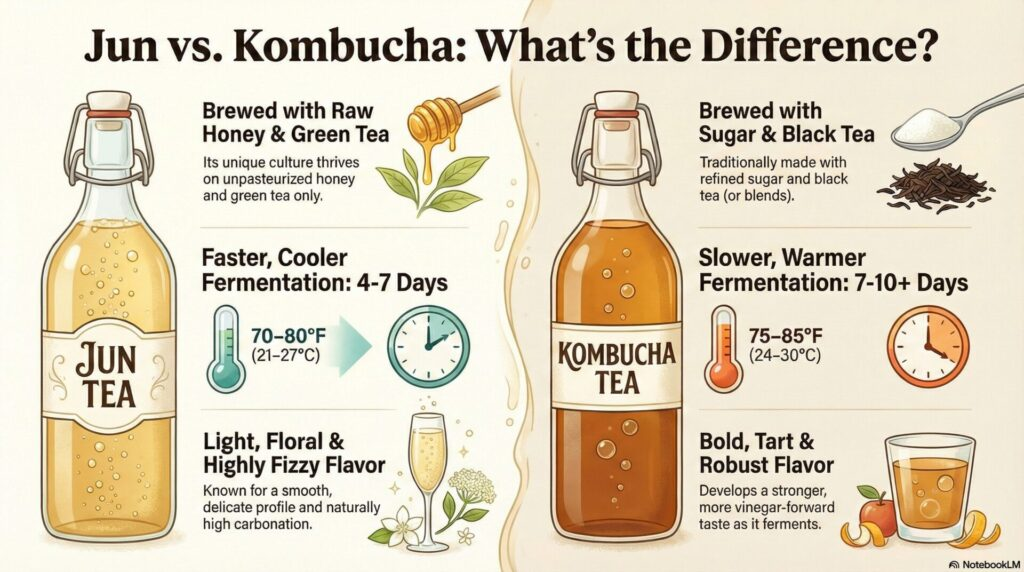
One of the things that makes kombucha great is that you can add a variety of flavors, so you’re never bored with the same old kombucha.
Every batch will already taste a little different because of varying concentrations of different bacterial strains, but adding flavorings will open up a whole new world of kombucha flavors.
What to Add
There aren’t really any rules for how you flavor your kombucha, so you’ll have to experiment to find what works best for you and which flavors you like.
You can add fresh or dried herbs, spices, fruit juices, fresh or frozen fruits and berries, or any combination of these to produce a complex, deliciously flavored kombucha that you’ll love.
When to Add
You’ll always want to add these at the end of the initial brewing process.
If you’re doing batch brews, that means at the end of the brew.
For continuous brewing, you’ll add flavoring when you remove the kombucha you’re going to drink.
If you’re going to do a second brew, then you’ll do this before that second brew.
Second Brew
To get a fizzier kombucha, you’ll want to do a second brew.
First, put the kombucha into airtight bottles.
Then, add the flavoring.
If you’re not adding any fruits or juices, you’ll need to throw in a couple of raisins or a small amount of honey to feed the bacteria during the second ferment.
Then, seal the bottle tightly and allow it to sit at room temperature out of direct sunlight for 1 – 3 days.
The amount of time you need to do the second brew will depend on how much fizz you want and the temperature.
At higher temperatures, the kombucha will ferment faster, so you need less time.
At lower temperatures, it will need a few more days.
When you’re happy with it, you can refrigerate the bottles to slow or stop the fermentation.
How to Add
When adding fruit, the best way to get a more intense flavor is to cut or crush the fruit into the smallest possible pieces because the more surface area of the fruit that is in contact with the kombucha, the stronger the flavor will be.
Adding fruit will also give you a much sweeter kombucha compared to adding herbs and spices alone.
You’ll need to add about ½ cup for every 3 – 4 cups of kombucha.
When adding herbs and spices, it’s best to do a second ferment so they have time to disperse their flavors throughout the kombucha.
Generally speaking, dried and crushed herbs and spices will produce a stronger flavor more quickly than fresh herbs.
Here’s our list of common kombucha additives and how much to add per 3–4 cups of liquid.
- Cardamom – 2 pods
- Cinnamon – ½ inch of a stick, crushed
- Fennel seed – 2 teaspoons
- Vanilla – 1 split bean
- Ginger – ½ inch grated fresh
- Lavender buds – 1 tablespoon
- Hibiscus leaves – 1 tablespoon
- Rose petals – 1 tablespoon
Don’t be afraid to get creative with your mixing and matching of fruits, herbs, and spices to make your own unique kombucha flavors.
In the next part, we will delve deeper into the equipment and supplies you need to produce your own Kombucha.
Brewing Equipment & Supplies
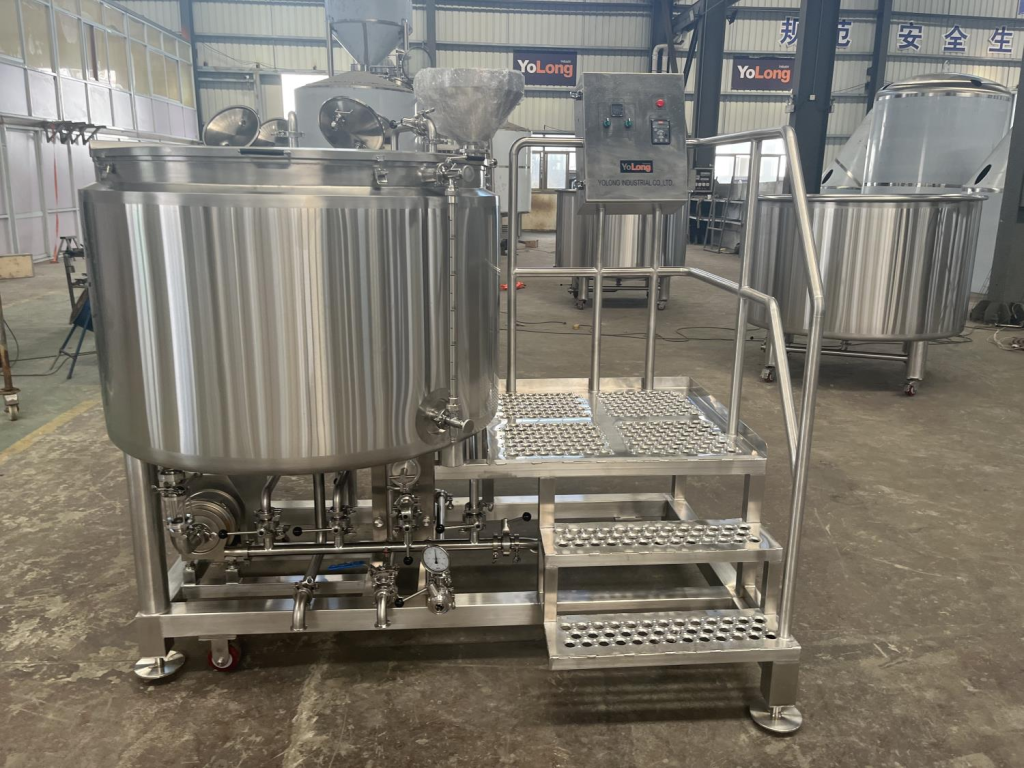
When it comes to brewing kombucha, there are a lot of options that you can find on the market today.
Choosing the right supplies will make a huge difference in whether you can successfully brew kombucha at home.
Here, we’re going to outline the basic supplies that you need to get started to help you set up your system right the first time.
Container
This is easily the most important part of your kombucha-brewing operation, as you can’t make kombucha without something to ferment it in.
We’ll start with the material of the container.
You never want to brew kombucha in plastic because it can leech harmful chemicals into your kombucha, crystal because it contains lead, or metal because it will react with the acids.
You could use ceramic or porcelain containers for kombucha, as long as they are food-grade, since many decorative pieces contain lead and other harmful chemicals.
However, the best container for kombucha is glass.
It’s non-reactive, safe, and relatively cheap.
Plus, it’s easy to find glass containers in a variety of sizes so you can brew as much or as little kombucha as you want with a few containers.
Container size is the next thing that you’ll need to consider.
You’ll not only need enough space to make enough kombucha to last through the next brewing cycle, but you’ll also need to be able to mix the ingredients in the proper ratios.
Since every batch takes the same amount of time, regardless of size, the smallest container we recommend is ½ gallon, though 1 gallon is the most popular.
The surface area of your container will affect the brewing time: larger surface areas brew kombucha more quickly than smaller ones, so you’ll want to find a happy medium.
If the kombucha ferments too quickly, it will taste more sour.
The ideal surface area for brewing kombucha is 5–6 inches.
When choosing a jar with a spigot, be sure to follow the same material recommendations, as the spigot will come into contact with the kombucha, and using a plastic or metal spigot can cause the same problems as using a plastic or metal container.
Fortunately, there are plenty of spigots to choose from that will work for kombucha brewing.
Jar Covering
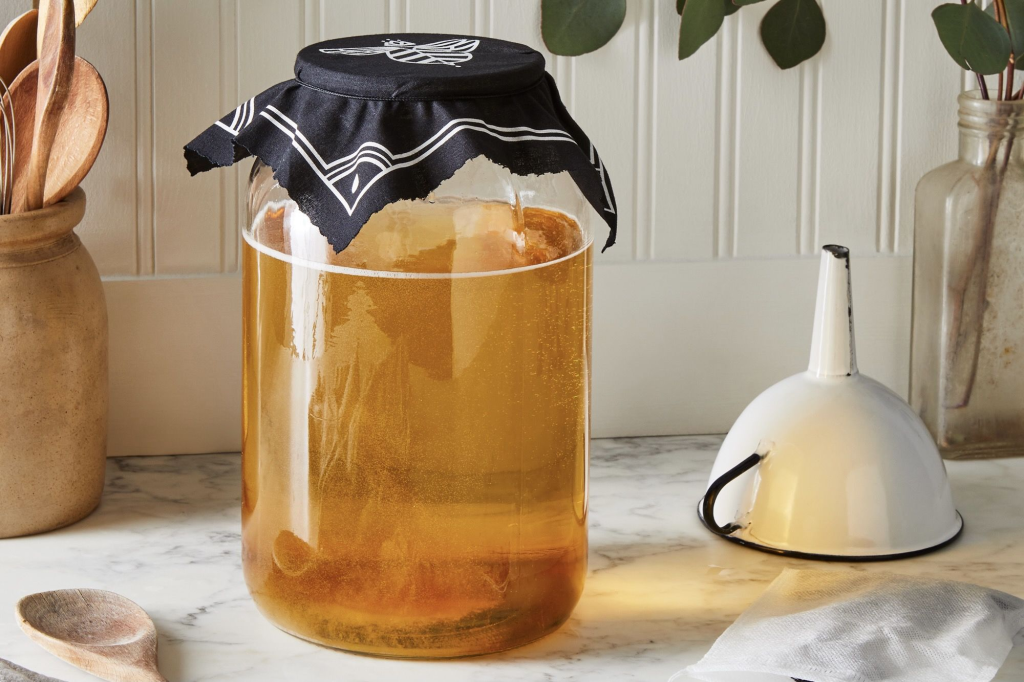
Covering your jar with the right material will keep out unwanted visitors like fruit flies and ants, while still allowing the airflow needed for proper fermentation.
You can secure your material with a rubber band.
The best materials to use as a jar covering for your kombucha are coffee filters, tight-weave dish towels, butter muslin, or even t-shirt material.
Other Supplies
Some additional supplies that will help you with brewing kombucha but that aren’t necessary to get started include tea balls or reusable tea bags for brewing the tea, a food-grade plastic strainer that you can use to scoop out the mother and baby SCOBY’s, sealable bottles for second brewing and storing finished kombucha, a funnel to help with bottling, and a stick-on thermometer to keep track of the temperature of your brewing area.
Now that we’ve learned about the equipment and supplies you need to brew your own kombucha, it’s time to look at exactly how to make it and at different ways to use it, since it’s not just a drink!
Not Just a Drink – Ways to Consume Kombucha & Cooking
One of the best things about kombucha is that it’s not just a drink.
In fact, there are a number of different things that you can do with kombucha in order to really enjoy this delicious drink.
These are especially great if you are brewing more kombucha than you can drink, as you can use them in different ways so they don’t go to waste.
1. Popsicles
Perfect for hot summer weather, you can use your favorite popsicle mold or even just paper cups to make popsicles with your kombucha.
This is especially good with berry and other sweet-flavored kombuchas, but any type will work.
Then, whenever you want to enjoy a cold, refreshing, and healthy treat, just grab one from the freezer!
2. Pickling
This is especially perfect if you grow your own produce and if your kombucha went a little too long and started to taste like vinegar.
Fortunately, instead of tossing it out, you can toss it in a jar with your fresh produce and let it start pickling.
This is a great way to ensure that you’re not wasting any of the overly sour kombucha and to make your pickled veggies more flavorful and healthy.
3. Ice Cream Floats
If there’s one thing that can’t be beat on a warm summer evening, it’s an ice cream float.
But, with all the sugars, calories, and unhealthy ingredients that come with soda, it’s not something the health-conscious can enjoy in good conscience.
However, by replacing the soda with a lovely fizzy kombucha, you can enjoy your ice cream floats all summer long.
4. Sourdough Starter
If you’re into other fermented foods besides kombucha, then you know that sourdough is a delicious and nutritious bread.
What you may not know is that you can actually use kombucha to start a batch of sourdough at home!
To get a sourdough going, all you need to do is mix equal parts flour and kombucha together, and it will be ready the next day!
5. Vinaigrette
Another great use for kombucha that’s gone a little too vinegary is to make it into a vinaigrette.
You can find recipes that specifically call for kombucha as the base for a vinaigrette, but you can also simply replace the vinegar of your favorite recipe with kombucha for a healthier but equally delicious vinaigrette.
6. Smoothies
If you love drinking smoothies, why not give your smoothie blend a probiotic kick by adding kombucha in place of some or all of the liquid?
These work particularly well for berry smoothies and will also kick up the tart factor.
You could also freeze kombucha in ice cube trays and add it to your smoothies that way if you normally use ice.
7. Gummies
If you’re looking for the perfect healthy treat that’s both delicious and great for your body, consider making some gummies with your extra kombucha.
These tasty snacks are easy to make, and they’re delicious.
Plus, you get the advantage of getting a few more probiotics!
Craft Brewed Kombucha
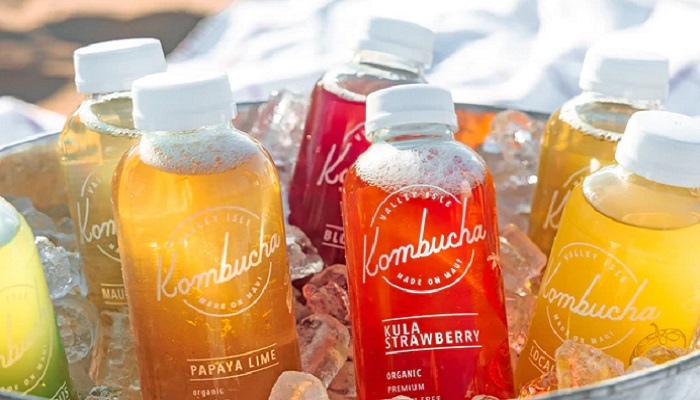
Much like craft beer, craft-brewed kombucha is commercially sold, made in small batches.
Most bottled kombucha you find in stores is made this way, and most of the companies are small local businesses.
Here are some reasons to try craft-brewed kombucha, even if you’re planning on brewing your own.
Support Local Businesses
Because so many craft-brewed kombucha businesses are local, buying from them is a great way to support the people in your community, rather than a big corporation that’s doing quite well already without your business.
Often, these craft-brewed kombuchas are equally, if not more, delicious than those produced by larger companies, so it’s worth the extra effort to find them.
Gain Insight on Brewing Techniques
As you’re meeting with craft-brewed kombucha business owners, you’ll be able to gain valuable insight into kombucha brewing and flavoring techniques.
These kombucha enthusiasts often have many years of experience, so they’ll be able to help point you in the right direction when it comes to getting the right supplies and with any problems you run into along the way.
Find New Flavors to Try
Craft-brewed kombucha comes in an enormous variety of flavors, so you’ll not only never be bored when trying the different types, but you might also get some new ideas for how you can flavor your own kombucha.
If you’re thinking of bottling your own kombucha to sell, you’ll need to avoid stealing flavors from other local sellers, but using it for your own batches at home is ok.
Stay Healthy
Since craft-brewed kombucha has the same health benefits as the stuff you’re brewing at home, it’s a great way to stay healthy when you’re first getting started and may not have enough kombucha to last you until the next batch is ready.
Most kombucha enthusiasts encourage drinking it every day, so if your supply runs out, pick up a craft brew, and you’re on your way to staying healthy, even without your own home-brewed kombucha.
Where to Find Craft-Brewed Kombucha
The best place to start your search for local craft-brewed kombucha is at farmers’ markets.
Many small brewers will bring their kombucha to these to sell, so it’s a great place to start looking.
This is the best place to find craft-brewed kombucha because the owners are likely the ones selling, so it’s easy to connect with them and share ideas about brewing kombucha.
Another place you can usually find craft-brewed kombucha is health food stores.
Most health food stores will carry a variety of kombuchas that you can try.
Many regular grocery stores and sometimes even larger convenience stores will carry this drink.
Typically, the drink’s popularity in your area will determine how easily it can be found.
Starting Your Own Craft-Brewed Kombucha Business
If your friends who try your kombucha are telling you that you should try selling your kombucha, and you find yourself being overwhelmed with the gallons you’re producing once things get going, starting a craft-brewed kombucha business might be a good idea.
Be sure to do a lot of research on the health and safety requirements for selling food before you get started, and make sure you have a place to sell your kombucha, whether it’s at the farmer’s market or your local health food store.
Conclusion – Making Kombucha Part Of Your Lifestyle
Congratulations on making it to the end of this short, introductory guide on Kombucha.
You may be surprised to learn that most people who start something never complete it.
Take your time and progress at your own pace.
This is not a race.
The more you understand and comprehend about kombucha and whether you decide to brew your own or buy ready-made from stores, the better
If you really want to succeed, everything you do for your body & health must be planned with long-term goals in mind.
These changes you’re making for your overall health are not meant to be temporary.
They’re meant to be part of a new lifestyle that you follow.
You can’t think of kombucha as simply as something that you add to your day.
Kombucha and your health must instead be something that your life is about and only then can you truly reap the benefits of this ancient fermented tea known as “The tea of Immortality”
I wish you all the success with making kombucha part of your daily life.
Tutorial – How To Make Kombucha
While it’s always nice to pick up a Kombucha drink from the store, the main way people produce Kombucha is by brewing it themselves.
In this part of the guide, we’re going to look at how to brew your own Kombucha at home
First of all, watch the video that explains it thoroughly…
Ingredients For Making Kombucha
The materials and ingredients needed to make Kombucha are simple.
You need glass jars to make it in, tea (either bags or loose leaf) sugar, and a Kombucha culture or SCOBY
The choice/brand of tea is up to you, and the type of sugar is also unimportant, as long as you get an adequate amount.
Sugar is vital for the fermentation process, and for those wanting a low sugar drink, it’s just a matter of fermenting it for sufficient time to bring the sugar level down very low
How To Brew
Get a glass jar with a volume of up to 1 litre, and ¾-fill it with boiling water, then add two black tea bags. (2-3 tea bags per 800-1000ml)
Leave to draw/brew for at least 15 mins, then add 60-70g of plain, white sugar (approx 1/4 cup max for a full litre, less sugar if less than a litre) and stir to dissolve (80-90g max for 1 litre).
You can use raw or cane sugar if you want, tho it makes little difference.
Remove the tea bags and leave them to cool to room temperature (it will take a few hours).
(Note: Always use a glass jar or container to brew your Kombucha, as it becomes more acidic as it brews and can react with plastic or metal containers.
Once the sweetened tea has cooled to room temperature, pour at least 3 Tablespoons of the supplied kombucha tea or starter (also at room temperature) into the jar, then carefully add your supplied kombucha scoby/culture to the jar as well.
It may float or sink and it doesn’t really matter which it does.
Place the jar in your pantry or somewhere out of direct sunlight (to avoid temperature extremes) and cover the top with muslin or another breathable fabric to keep ants and fruit flies out while still allowing air to flow in and out of the jar.
Air is needed by the yeast and bacteria in the scoby to breathe.
Leave it for at least 4-5 days to ferment/brew.
During this time, a new scoby or ‘baby’ will form on the surface of the tea, and if your original one was floating, the new ‘baby’ will most likely adhere to it.
After 4-5 days, check it to see if bubbles are starting to form under the surface scoby.
If it is, try to carefully draw a little bit out with an eye dropper or pipette by carefully tilting the jar on its edge to taste it.
If it’s still really sweet and not very bubbly, leave it another day, then test again.
If it’s really fizzy and only slightly sweet, it’s ready.
If it tastes vinegary, it’s been left too long.
Ultimately, you bottle it off when it reaches the level of flavour that you personally like.
When testing, try not to submerge or expose the top of the Scoby to water, as it stalls the fermenting process because the wet layer slows oxygen transfer to the bacteria and yeast.
What Next?
When it’s ready, pour off 80-90% of it to drink straight away, or bottle it to drink over the next few days.
Take the remaining 10+% and the now 2 scobies and start a new batch with another brew of sweetened tea as per the start of these instructions.
Using 2 scobies in the second batch should give you an even better result than the first.
It may take two or three brews to get it really working well.
A scoby of 3 or 4 layers/generations gives a good, consistent brew.
Be patient.
After the third or fourth brew, you can peel off the older scobies and use them to start a new/second brew in a new jar.
You may soon learn that you may need/want 3 or 4 bottles brewing at once, or use a larger glass jar if you can find one, to make enough for everyone in the household to have a glass each day.
Experiment with different flavoured teas or herbal/fruit infusion teas, but always use at least one or two black or green tea bags, as many of the herbal/fruit teas contain very little actual ‘tea’ leaves, and the tea is necessary for the scoby to feed on.
The SCOBY
As for the ‘Scoby’ I have found that a scoby that is three or 4 layers (generations) thick gives the best flavoured drink so don’t be surprised or disappointed if your first batch is nothing to rave about.
Simply put both the original/mother scoby and the newly grown scoby/baby into a new batch of tea for the second week, and you should get a better brew next time round.
2 or 3 scobies in a brew seem to yield better results than a single scoby.
In colder weather, the Scobies may not grow as fast or become as thick as in summer, but they will still give a good brew, and as long as the Kombucha still brews and tastes good, then the size of the Scobies matters little.
Stuck together layers of scoby float better than single ones, too, because of the air trapped between the layers, so I like to keep my scobies at 2-4 layers thick and floating on the surface
If your scoby sinks in a new batch of tea, it just means the new one that forms on the surface won’t be stuck to it (obviously).
If your scobies always float and get thicker each week, peel off the older bottom layer or two so that it doesn’t take up too much volume in the jar.
If they don’t float, simply throw out the ones that turn dark brown with age and use only the newest 2 or 3 generations.
What to do with the old scobies?
Give them to friends to start their own kombucha, start another jar/batch yourself, or simply throw them out.
Remember, it’s all about experimenting, finding what works best for you in your situation, and what kind of flavour you like