How To Preserve Eggs: 7 Proven Methods That Keep Eggs Fresh For Months Without Refrigeration

Preserving eggs is something most folks don’t think about nowadays.
With grocery stores and refrigerators, they don’t need to.
The homesteading lifestyle, however, with its goals of simpler, more self-reliant, often off-grid living, raises the question for a whole new generation of folks.
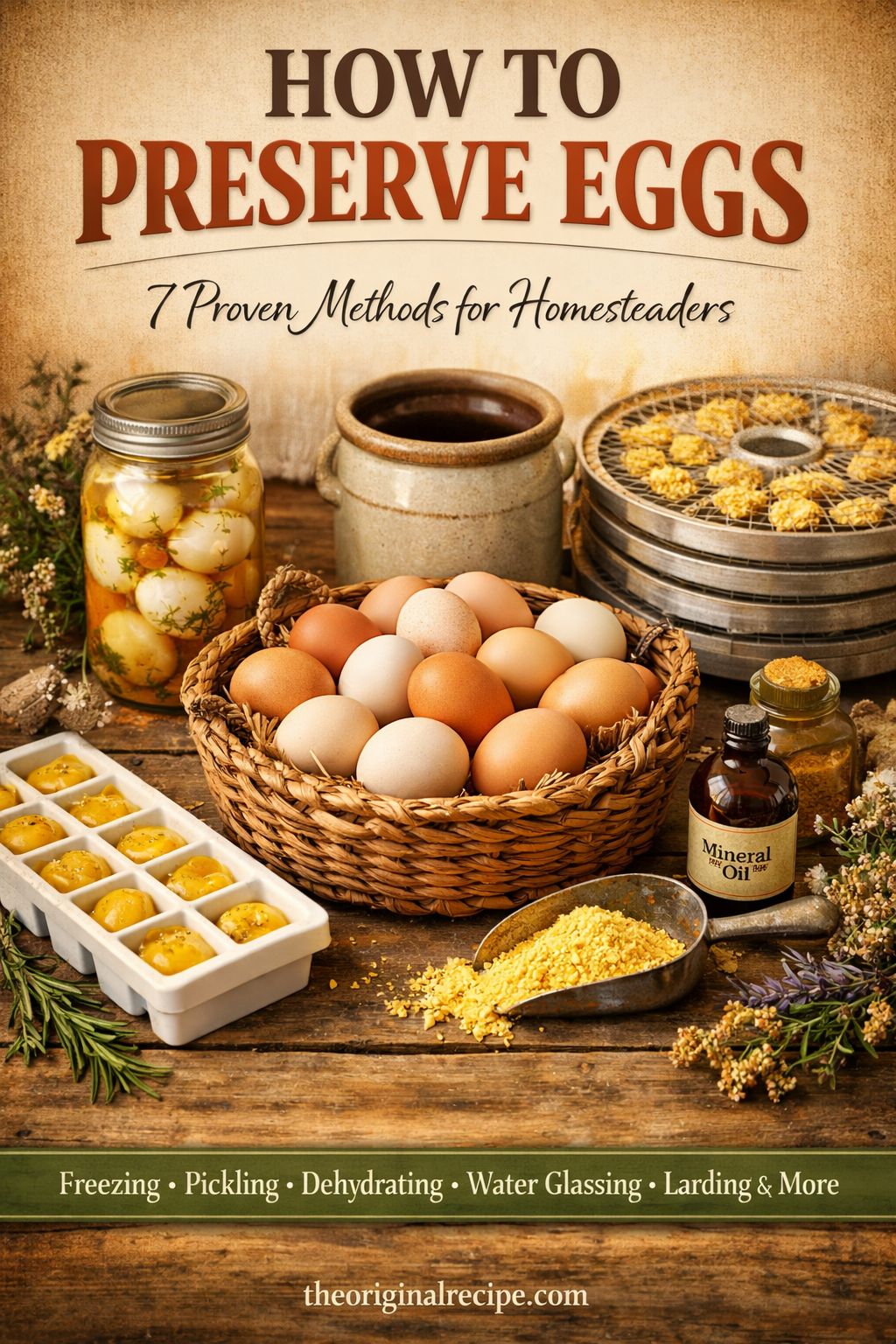
The methods in this guide cover both historic and modern solutions to the problem of seasonal supply.
All of them are in use today.
One question I don’t specifically address is how long eggs will keep with each of these methods.
From my reading, research, and personal experience, I don’t think there is a specific answer to that question.
For example, water-glassed or oiled eggs will likely keep longer in an unheated basement in northern Michigan than on a kitchen counter in southern Alabama.
Much will depend upon storage temperature.
Without any extra steps toward preservation, eggs have a pretty good shelf-life, especially with refrigeration.
Check the expiration date on grocery store eggs to see what I mean.
They are considered safe to eat 4 to 5 weeks after the expiration date.
Grocery store eggs have been washed, of course, but eggs do have their own natural protective coating.
This is known as the “bloom” or cuticle.
The bloom coats the porous eggshell, protecting it from potential bacterial invasion.

It is those bacteria that contaminate the egg contents, causing it to become rotten.
Washing the egg removes the bloom and reduces its shelf life.
Of particular interest in this topic is the research done by Mother Earth News.
They did extensive testing of egg freshness on both store-bought and homegrown eggs, using most of the techniques described in this guide.
The results make a good case for not washing eggs.
Also, they are good candidates for preservation.
See the bibliography for a link to the article.
Common Sense Rules for Egg Preservation

For all egg preservation techniques, common sense applies:
- Never use broken, cracked, or dirty eggs for storage.
- Use the freshest eggs possible.
- Use unwashed eggs if possible.
- When using stored eggs in the shell, crack each one separately into a measuring cup or small bowl. If it looks or smells funny, discard it.
- Never consume raw. Always make sure your preserved eggs are properly cooked before eating.
- Lastly, learn to adjust your meal planning and recipes to what’s available. This is what seasonal eating is all about. During the summer, my husband Dan and I eat eggs every day. During winter, we eat fewer eggs and more of other things. Still, it’s nice to have eggs. Most of these techniques should keep eggs available throughout the months when the chickens aren’t laying.
How To Determine Egg Freshness

First things first.
The methods discussed in this guide will have the best results if the freshest possible eggs are used.
A simple, time-honored way to determine freshness is with the float test.
Float Test
Place the eggs in a bowl or pan of water.
The freshest eggs will lie on their sides on the bottom.
As the eggs age, one end will begin to turn upwards.
An egg that remains on the bottom but in an upright position is about at the end of its shelf life.
Eggs that float need to be discarded.
Why Does This Work?
Eggshells are porous, allowing the contents to evaporate over time.
This creates an enlarging air bubble within the egg.
That air bubble causes the egg to float.
How To Freeze Eggs
My husband and I eat a lot of eggs because we have a lot of eggs.
Sometimes too many.
Freezing them is an easy and simple way to preserve extra eggs when the hens are laying abundantly.
It ensures eggs for baking and omelets when the chickens are molting, or when daylight hours grow short, and so does the supply of homestead eggs.
Eggs can be frozen whole, or whites and yolks can be frozen separately.
What You’ll Need
- Mixing bowl
- Egg whisk or egg beater
- Ice cube tray or
- Muffin tin
- Fresh eggs
Beat the eggs as for scrambled, adding salt if desired (1/2 tsp per cup of eggs).
Pour into ice cube trays or muffin tins and freeze.
How Many Eggs?
As with most other homestead projects, there is no one-size-fits-all way of doing things.
To answer that question, there are several variables to be considered.
One is the size of the ice cube tray or muffin tin, the other is the size of the eggs.
Egg Sizes by Weight
Eggs are technically sized according to weight.
The most common commercial sizes are:
- Extra large = greater than 2.25 oz. (64 g)
- Large = greater than 2 oz. (57 g)
- Medium = greater than 1.75 oz (50 g)
Egg Sizes by Volume
I find it easier to think of them in terms of volume.
Conventionally accepted volumes for eggs are:
- Extra large egg = 4 tablespoons
- Large egg = 3.25 tablespoons
- Medium egg = 3 tablespoons
Even so, if you have a flock of mixed-breed chickens, as I do, then you likely get different-sized eggs.
How do I know how many eggs an ice cube tray will hold?
By experimenting, I learned that my ice cube tray holds 10 beaten eggs of mixed sizes.
If a recipe calls for one large egg, I use two cubes.
A standard muffin tin holds two eggs per muffin cup, so it takes twenty-four raw, beaten eggs to fill the tin.
This is actually a more convenient size for me, although I still like the egg ice cubes too.
Once frozen, they can be removed and stored in plastic freezer bags until needed.
I find them easier to remove if I first spray the tin or tray with a vegetable spray.
If needed, set the bottom in cold water for several seconds.
How Do Frozen Eggs Taste?
Frozen eggs work well for scrambled eggs, omelets, quiche, or baked goods.
It only requires a little planning ahead to defrost them.
When defrosted, they look just like fresh eggs.
But how do they taste?
Do they pass muster?
Judge for yourself.
Here’s a snippet of a conversation between my husband and me the first time I scrambled them for lunch.
Me: “Well?”
Dan: “Well, what?”
Me: “How are they?”
Dan: “How are what?”
Me: “The eggs! How do they taste?”
Dan: “Like eggs.”
Freezing Yolks & Whites Separately
If you wish, you may freeze yolks and whites separately.
According to the National Center for Home Food Preservation, yolks will require the addition of 1/2 tsp salt per cup of eggs or 1.5 tbsp sugar or corn syrup to prevent graininess.
Stir gently before freezing.
One tablespoon equals the yolk of one egg.
Whites do not need salt or sugar.
Don’t beat or whip before freezing, just stir gently.
Two tablespoons equals the white of one egg.
Eggs that remain in the freezer gradually dehydrate somewhat, but even after a year, I’ve used them in a pinch for baking, adding a little milk or water until I get a fresh beaten egg consistency.
They can also be defrosted and fed to cats, dogs, or pigs.
How To Use Frozen Eggs
To Use: defrost and use like beaten eggs in baked goods, scrambled eggs, quiche, etc.
How To Pickle Eggs
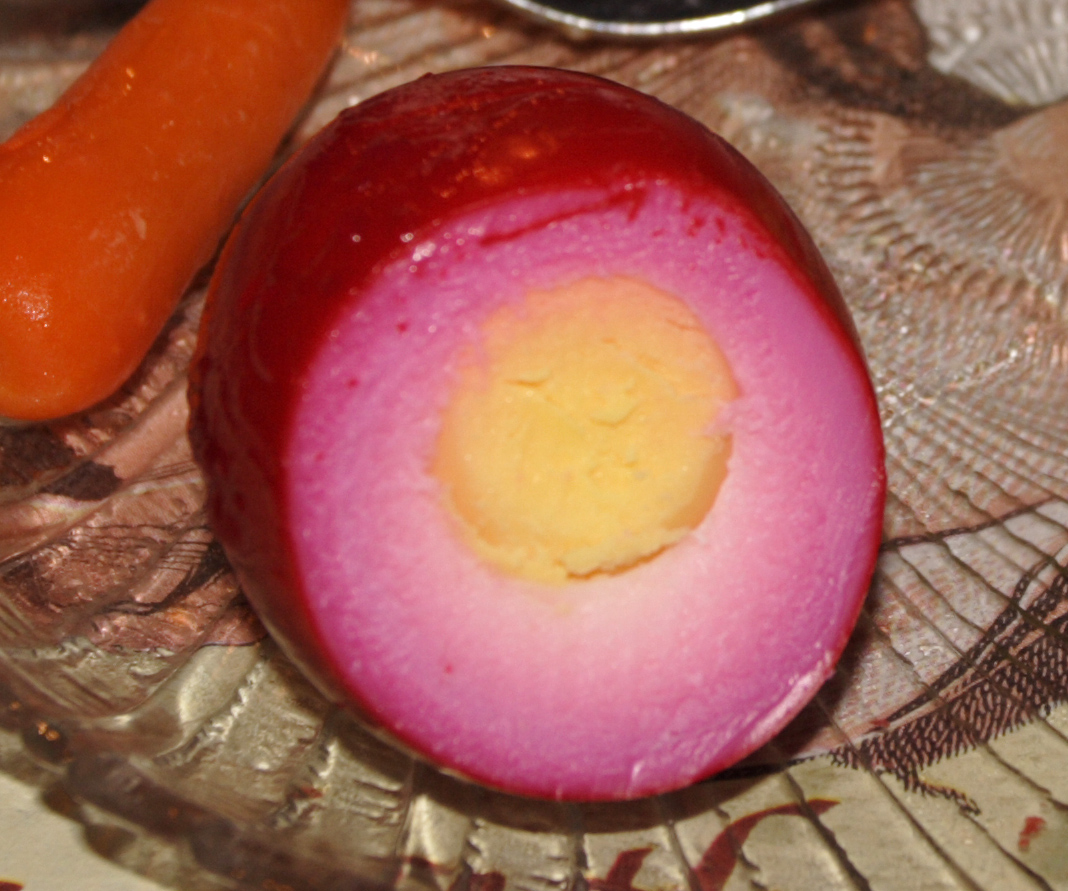
Pickling eggs is another easy, plus tasty, way to preserve hard-boiled eggs.
The recipe is simple, especially if made with leftover pickle juice.
I do this instead of making a special brine because I’m a waste-not-want-not kind of gal, so throwing out that pickle juice isn’t in my vocabulary.
I use it for cole slaw, salad dressing, and pickling eggs.
We prefer dill, rather than sweet, pickle juice for those eggs, but any leftover pickle brine can be used.
For pink eggs, add a little pickled beet juice.
What You’ll Need
- Wide mouth canning jar or crock with lid
- Leftover pickle juice
- Hard-boiled eggs, peeled
Eat the pickles and save the pickle juices.
Place peeled, hard-boiled eggs in a clean, wide-mouth canning jar.
Cover with pickle juice or brine, then let sit in the fridge for at least 1 week.
How To Store Pickled Eggs
To store: Unrefrigerated, these are said to keep for two weeks; refrigerated, they will keep for months.
How To Use Pickled Eggs
To Use: Pickled eggs make a nice snack on their own, can be added to fresh green salads, used to make deviled eggs, or used in egg salad for sandwiches.
How To Dehydrate Eggs

Back in my Y2K prepper days, one of the things I bought for my food storage was powdered eggs.
Of course, we didn’t need them for the much speculated Y2K disaster, but I did find them very handy to use at a time when I didn’t have chickens.
Dehydrating eggs is still a possibility for home preservation, with a couple of considerations.
Salmonella Concerns
Eggs can be dehydrated either cooked (as in dried scrambled eggs) or raw.
There are warnings about dehydrating raw eggs; however, due to concern about salmonella.
This is why commercially dehydrated raw eggs are pasteurized.
Salmonella is a fairly ubiquitous bacterium that causes food poisoning.
It is found both on the eggshell surface and within the egg itself.
Salmonella food poisoning outbreaks are usually associated with eggs produced by commercial farms and factories.
That would recommend not using store-purchased eggs for dehydrating.
It doesn’t mean that Salmonella can’t be a potential hazard with eggs from free-range chickens, just less likely.
Salmonella is killed at 160°F (71°C), so the precaution is to not use raw dehydrated eggs without cooking.
Shelf Life & Rancidity
A second consideration is shelf life.
Due to the high fat content of egg yolks, they won’t keep for more than 3 or 4 months before becoming rancid.
Rancidity can also be a problem for drying scrambled eggs cooked in oil.
Two possibilities exist here.
- 1) use a non-stick cooking pan, or
- 2) Use a saturated fat such as coconut oil, palm oil, shortening, beef tallow, lard, or clarified butter.
Saturated fats are more stable and less prone to rancidity.
Either way, if the dehydrated eggs can be vacuum-packed, refrigerated, or frozen, so much the better.
What You’ll Need
- Fresh home-laid eggs (i.e., not store-bought)
- Whisk or egg beater
- Bowl
- Skillet (for scrambling first if desired)
- Food dehydrator (equipped with a fruit leather tray if drying raw eggs)
To Dehydrate Scrambled Eggs
Cook in a skillet, spread out on food dehydrator trays, and dry at 145ºF (63ºC, setting for meat, fish, and jerky) until crisp and brittle.
These are best if powdered once cool.
They can be used as chunks, but the result is a somewhat chewy (okay, rubbery) scrambled egg.
To Dehydrate Raw Eggs
Beat as for scrambled, and pour into the fruit-leather-made trays for your food dehydrator.
Alternatively, you can use a cookie sheet or foil.
Set dehydrator temperature to 145ºF (63ºC).
Drying time is longer than for scrambled eggs, so working with smaller amounts is best.
Powder in a blender.
How To Store Dehydrated Eggs
To store: store in clean glass jars or containers.
Shelf life will be improved if they are kept in the refrigerator or freezer.
How To Rehydrate
To rehydrate: Mix equal parts powdered egg and warm water.
Allow to sit at least ten minutes before using.
How To Use Dehydrated Eggs
To Use: Dehydrated eggs must be thoroughly cooked before consuming.
Once rehydrated, these can be used in baking, just like fresh eggs.
They can also be scrambled or used in quiche.
How To Water Glass Eggs
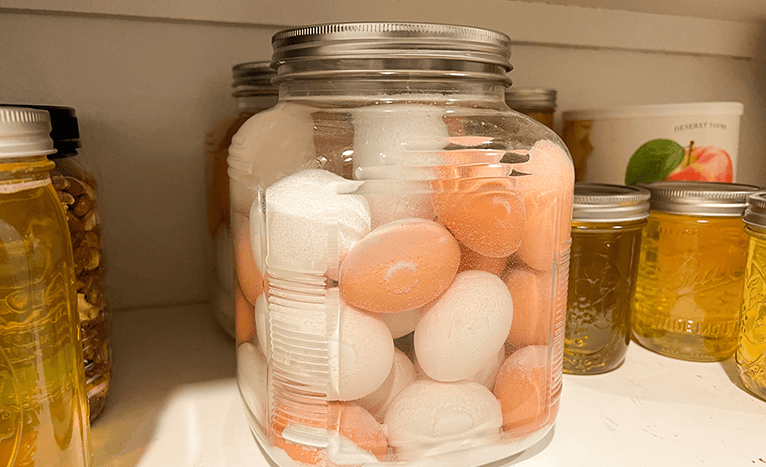
Before electricity was widely available, water-glassing eggs was a common way to preserve them.
Water glass (sodium silicate), was readily available at hardware and drug stores for that purpose.
It is a slippery, slightly alkaline liquid that is still used as a cement floor sealer and cardboard carton adhesive.
Unfortunately, it has become hard to find.
Because of that, it may not be a first choice for homestead egg preservation, but I include it as a useful method for an off-grid or non-electric situation.
What You’ll Need
- Clean, freshly laid, unwashed eggs
- A gallon crock or glass jar
- Water glass (Sodium Silicate)
- Water for diluting, boiled and cooled.
Instructions
Check eggs for cracks, dirt, or manure.
Do not use these.
Washing will remove the bloom and decrease the effectiveness of water glassing.
In the crock or jar, mix 11 parts water with one part water glass.
Add the eggs, ensuring they are submerged at least 2 inches below the liquid surface.
Cover the crock and check the contents from time to time because the water will evaporate.
Top off with water glass as needed.
How To Use Water Glassed Eggs
To use: wash the eggs as you remove them.
Break individually into a measuring cup or bowl to check for freshness.
Most sources say they’re best if used within five months.
How To Lard (Or Oil) Eggs
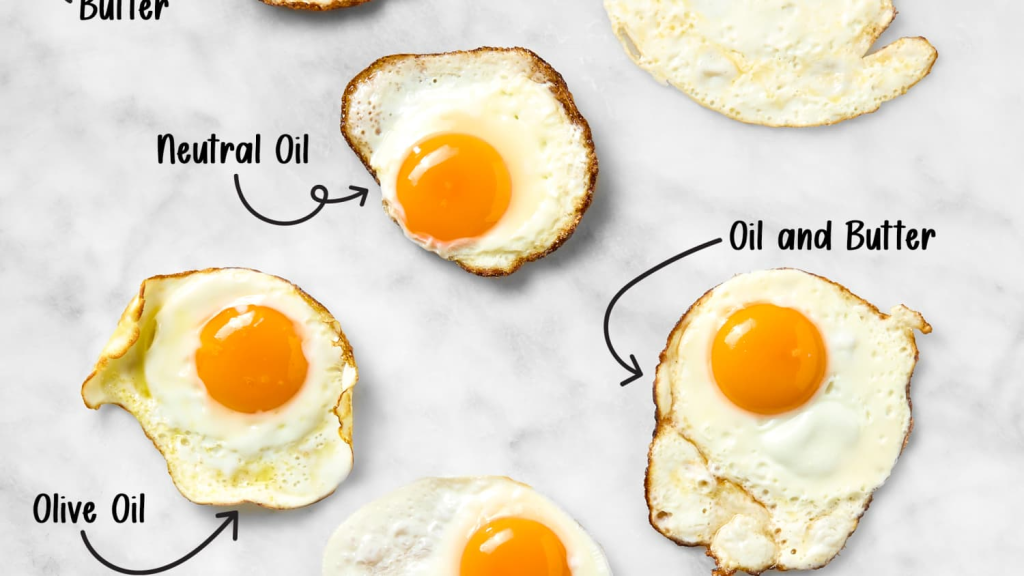
Larding eggs is another old-fashioned way to preserve them.
I’ve not tried this method, but it is said to work very well.
Eggs can be packed in a crock filled with lard, or coated with lard and packed in salt, sawdust, or oatmeal.
The Modern Version: Mineral Oil
The modern version uses mineral oil.
Mineral oil is touted by the cosmetics industry for “protecting” the skin.
Food-grade mineral oil is sometimes used by commercial egg producers to coat washed eggs.
Mineral oils such as baby oil contain perfumes and additives, and should not be used.
The eggs can be stored in cartons or packed in crocks with salt, sawdust, or oatmeal.
Why Does This Technique Work?
Why does this technique work?
Egg shells are porous.
The oily coating helps prevent or slow the evaporation of the liquid contents of the egg.
It also serves as an artificial “bloom,” helping to protect the egg from bacterial contamination.
A Note on Rancidity
I’ve read where some folks use coconut oil or butter to coat eggs for storage.
One consideration with using various fats and oils is rancidity.
Lard, coconut oil, and butter are saturated fats.
This means they are more stable and slower to go rancid than commonly used unsaturated vegetable cooking oils.
Mineral oil, on the other hand, is petroleum-based and does not turn rancid.
The cooler the storage area, the longer they will keep.
How To Use Larded Eggs
To use: Break individually into a measuring cup or bowl to check for freshness.
Use as raw eggs.
How To Have Fresh Eggs All Winter
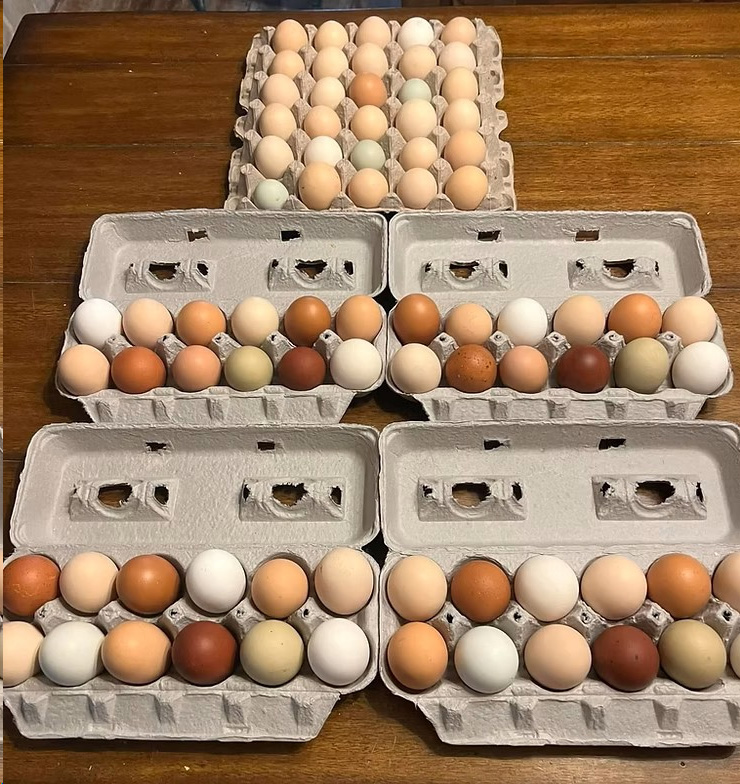
The first summer my hens started laying, I froze thirteen dozen eggs for winter use.
We did not plan to artificially light the coop, preferring to allow the chickens their natural seasonal cycle.
Imagine my surprise when I kept getting eggs all winter.
Production was down, only one to three eggs per day, but in the end I did not use a single one of my frozen eggs except to experiment.
Two factors are attributed to the winter laying layoff: molting and daylight.
Molting
Molting is the natural process by which a chicken renews her plumage; old feathers fall out, and new ones grow in.
During this time, she stops lying.
Regarding when that happens, several factors are involved: hatching date, breed, individual genetics, management techniques, and stress.
Hatch Date
A January or February hatched pullet will begin laying earlier than a July or August hatched chick, but will obviously have an earlier molt.
One strategy for year-round eggs is to allow for chicks hatched at different times of the year.
Egg production will still decrease during the winter months, but not all hens will molt at the same time.
Breed
Breed is another factor; in fact, some are actually considered winter layers: Buckeye, Chantecler, Delaware, Dominique, Faverolles, Jersey Giant, New Hampshire, Orpington, Plymouth Rock, Rhode Island, Sussex, and Wyandotte.
There are other factors to consider before choosing one of these, such as egg size, average production, breed purpose, etc., but the list gives you an idea of breeds to research further.
(For a more complete list of breeds, see “Bibliography,” for a link to John Henderson’s “Henderson’s Handy Dandy Chicken Chart.”)
Individual Genetics
Some chickens are early molters, others are late molters.
An early molter will begin her molt after about 8 or 9 months of laying.
A late molter will produce 12 to 15 months before beginning her molt.
How can you tell the difference?
Wing feathers tell all.
The early molter will drop her primary wing feathers one at a time.
The late molter will drop all of them at pretty much the same time.
Because of this, the early molters have a longer molt and longer cessation of egg production.
Management Techniques
The amount of daylight influences laying, so whether or not to provide artificial light during winter is a question to consider.
The reason for this is that the hen’s pituitary gland is sensitive to light, causing it to secrete the hormone responsible for ovulation, i.e making eggs.
Although artificial lighting is standard practice in commercial egg production, it is controversial among chicken owners.
Some prefer to allow their hens to complete the natural cycle of seasons.
We do, and I simply adjust the number of eggs we eat and use during the winter months.
I also rely on preserving eggs, as you might have already guessed. 😉
For those wishing to try this management technique, a 40-watt light bulb is enough to light 100 square feet of a chicken coop.
It doesn’t have to be a glaring light, just enough for a human to read by.
The key is to ensure at least 16 hours of light per day (total daylight and artificial light) and 8 hours of darkness for nighttime roosting.
Stress
Stress can reduce egg production.
Stress factors include disease, parasites, perceived threats (animal or human), changes in diet or weather, or improper management techniques such as overcrowding or poor ventilation.
Commercial egg producers actually use stress to force molting, because it increases production from older hens.
It is achieved by reducing artificial lighting and feed.
Interestingly, experiments utilizing these techniques indicate an increased presence of Salmonella.
Even when pulling together the best of the above, winter laying is commonly not as good as summer laying.
As with any local diet, cooking and eating is adjusted according to the eggs available.
Other Possibilities
There are a few other ways to preserve eggs.
I did not go into detail for these for various reasons, but I will mention them here.
Liming Eggs
Liming eggs.
Fresh eggs can be stored in a solution of 16 parts water, 1 part pickling salt, and 2 parts food-grade lime, such as pickling lime.
Although keeping quality is said to be good, the disadvantage appears to be that the eggs taste “limey” over time.
In Noodles
In noodles.
This idea comes from Carla Emery’s The Encyclopedia of Country Living.
The beauty of noodles is that they don’t need refrigeration for long-term storage.
In Baked Goods
In baked goods that can be frozen.
Instead of preserving the eggs, preserve the foods they’d be used for, such as cakes, muffins, cookies, pancakes, and breakfast breads.
I believe that’s about it!
If you know of another method, I’d love to hear about it.